GST Reforms: What They Mean for India’s Infrastructure and Equipment Businesses
After the Monsoon: What Lies Ahead for India’s Infrastructure and Construction Equipment Industry?
After the Monsoon: What Lies Ahead for India’s Infrastructure and Construction Equipment Industry?
India has no shortage of infrastructure projects. The real question in 2026 is how quickly those projects convert into execution, machine utilisation and cash flow on the ground.
India’s infrastructure and construction equipment industry is entering an important phase.
On one hand, FY2025-26 was relatively subdued for construction equipment sales. Domestic demand softened, project execution slowed in several sectors, contractor liquidity remained selective and the monsoon affected work across many regions.
On the other hand, India continues to carry a very large infrastructure pipeline.
The Union Budget has provided ₹12.2 lakh crore for public capital expenditure in FY2026-27, while the Centre had already spent about ₹3.40 lakh crore by the end of June.
At the same time, MoSPI was monitoring 1,847 Central Sector infrastructure projects valued at a revised ₹40.54 lakh crore, with more than ₹21.9 lakh crore already spent.
So the issue is not a lack of projects.
The real issue is how quickly approved and funded projects move into actual construction.
Construction equipment sales slowed, but demand has not disappeared
India’s construction equipment industry sold around 1.37 lakh machines in FY2025-26, about 2% lower than the previous year.
Domestic demand declined by roughly 7%, although exports increased strongly.
Earthmoving equipment remained the largest category, accounting for about 71% of industry volumes. Road construction equipment was one of the few segments to record positive growth during the year.
This does not look like a structural fall in infrastructure activity. It looks more like a delay between project awards and project execution.
A project may be approved today, but equipment demand begins only when land is available, contractors mobilise, payments start flowing, subcontractors are appointed and physical work actually begins.
For the equipment industry, the mobilisation date is often more important than the announcement date.
A large amount of work is already under execution
The existing project pipeline is significant.
Of the 1,847 projects being monitored by MoSPI, transport and logistics alone account for more than ₹22 lakh crore.
Roads and highways, railways, urban transport, ports, aviation and other infrastructure projects continue to provide a deep base of potential equipment demand.
There is also an interesting mix within the pipeline.
Hundreds of projects are already nearing completion, while many others are still in early stages.
That creates demand at both ends.
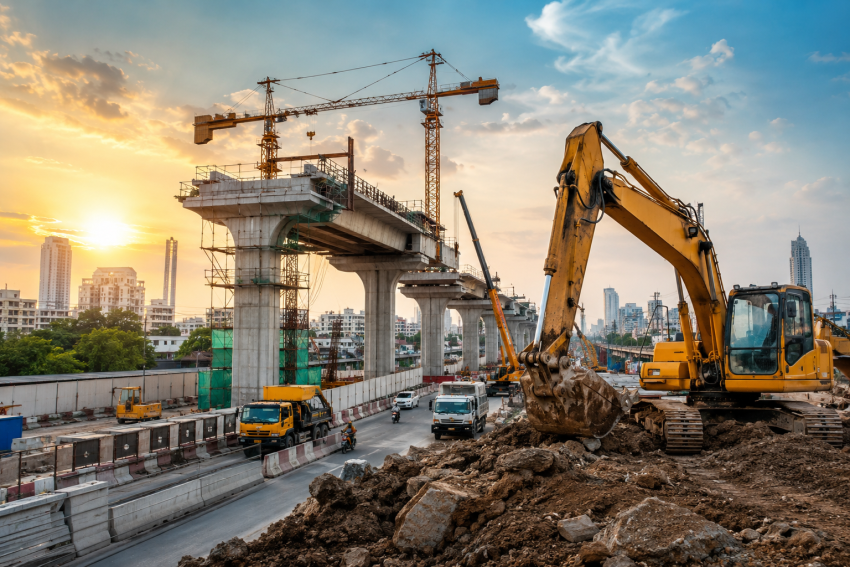
Projects nearing completion require cranes, concrete equipment, pavers and finishing machinery.
Newly mobilised projects require excavators, loaders, dozers, graders, rollers, crushers and other earthmoving equipment.
New highway projects are also continuing to enter the pipeline, including major corridors around Varanasi, Assam, Kanpur and other regions.
The opportunity is therefore visible.
The key question is which projects will actually open construction fronts during the coming months.
The monsoon remains a major operational factor
The 2026 monsoon has been weaker than normal at the national level, but rainfall has been uneven.
Up to early August, rainfall across India was around 11% below the Long Period Average, with large regional differences.
For construction companies, however, national rainfall averages do not tell the full story.
A few days of very heavy rain can stop excavation, damage access roads, flood foundations, affect compaction, slow quarry operations and interrupt project movement.
So even a below-normal monsoon can create serious local disruption.
This year’s post-monsoon recovery is therefore unlikely to happen at the same speed across every region.
Some states and projects will restart quickly, while others may take longer depending on soil conditions, waterlogging and local weather.
Diesel is becoming a bigger part of equipment economics
Fuel costs are another important issue.
The Delhi diesel benchmark increased from around ₹87.67 per litre in February to ₹95.20 by the end of July.
That is a rise of more than ₹7 per litre in a few months.
For heavy equipment, the impact becomes meaningful very quickly.
A machine consuming 20 litres per hour could see fuel costs rise by around ₹150 per operating hour.
At 30 litres per hour, the increase is more than ₹220 per hour.
For larger machines consuming 50 litres per hour, the additional cost can be close to ₹375 per operating hour.
Over a full shift, the impact can run into several thousand rupees per machine per day.
This matters especially where rental or subcontract rates are fixed and do not adequately account for changes in diesel prices.
As activity improves, machine utilisation may increase, but profitability will depend on whether rates also reflect higher operating costs.
There are early signs of stronger execution
Recent industrial data is encouraging.
In June 2026, India’s Infrastructure and Construction Goods output increased by 7.5% year-on-year.
Cement production increased by nearly 10%, while Capital Goods output grew by more than 14%.
These indicators suggest that construction and infrastructure activity was already beginning to improve before the monsoon ended.
Government spending is also moving relatively quickly.
By June, the Centre had already spent nearly 28% of its annual capital expenditure budget.
Railway expenditure has also been progressing at a strong pace.
These are important signals for the construction equipment industry because stronger execution generally appears first in material consumption, project mobilisation and equipment utilisation before it fully appears in new machine sales.
What happens after the monsoon?
The most important period will likely be October 2026 to March 2027.
The base case is positive, but not one of a sudden nationwide boom.
A more realistic expectation is gradual acceleration.
As project sites reopen, contractors are likely to first use their existing fleets more intensively.
Idle machines will be redeployed.
Equipment will move from completed or slow-moving sites to active projects.
Rental demand may increase where contractors need machines quickly but do not yet want to commit to fresh purchases.
Only after utilisation remains strong for some time are contractors likely to make larger fleet-expansion decisions.
For that reason, equipment utilisation could improve before OEM retail sales do.
That distinction will be important in the second half of the year.
Which equipment categories may see demand first?
Earthmoving equipment should continue to benefit first as new construction fronts open.
Excavators, loaders and dozers are used across highways, railways, industrial projects, mining, irrigation and urban infrastructure.
As projects progress, demand should move towards graders, compactors, rollers, crushers, pavers and asphalt-related equipment.
Concrete equipment should benefit once structural work gathers pace.
Cranes and specialised lifting equipment will depend more on metro, bridge, industrial and energy projects.
The larger point is that equipment demand depends not only on the value of a project, but on the stage of construction it has reached.
A ₹5,000-crore project in the approval stage creates less immediate equipment demand than a much smaller project that has already mobilised multiple construction fronts.
The biggest challenge may be economics, not availability of work
There is enough infrastructure activity to remain constructive on the market.
But higher utilisation does not automatically mean higher profitability.
Contractors still face challenges around working capital, payment cycles, land acquisition, execution delays and rising operating costs.
Equipment owners face diesel costs, operators, maintenance, tyres, spares, finance costs and transportation.
A machine running more hours at an unsustainable rate can still lose money.
This means the industry is likely to pay more attention to cost per productive hour, rather than only purchase price or daily rental rate.
For OEMs, rental companies, contractors and equipment owners, productivity and operating efficiency will become increasingly important.
The outlook for the second half
The industry enters the post-monsoon period with a strong infrastructure base.
There is ₹12.2 lakh crore of government capital expenditure, more than ₹40 lakh crore of monitored Central Sector projects, improving construction-material indicators and a continuing pipeline of highways, railways and other infrastructure work.
Against that are higher diesel costs, uneven contractor liquidity and project-level execution bottlenecks.
The most likely outcome is therefore neither a dramatic boom nor continued stagnation.
It is a period of progressive improvement in execution and equipment utilisation.
October should see construction fronts reopen in many parts of the country.
November to February could become the strongest execution window, particularly for highways, railways, industrial construction, urban infrastructure and projects working towards March deadlines.
If this improvement continues, the larger impact may become visible in equipment purchasing during 2027.
For the next few months, however, the most important indicator may not be how many machines are sold.
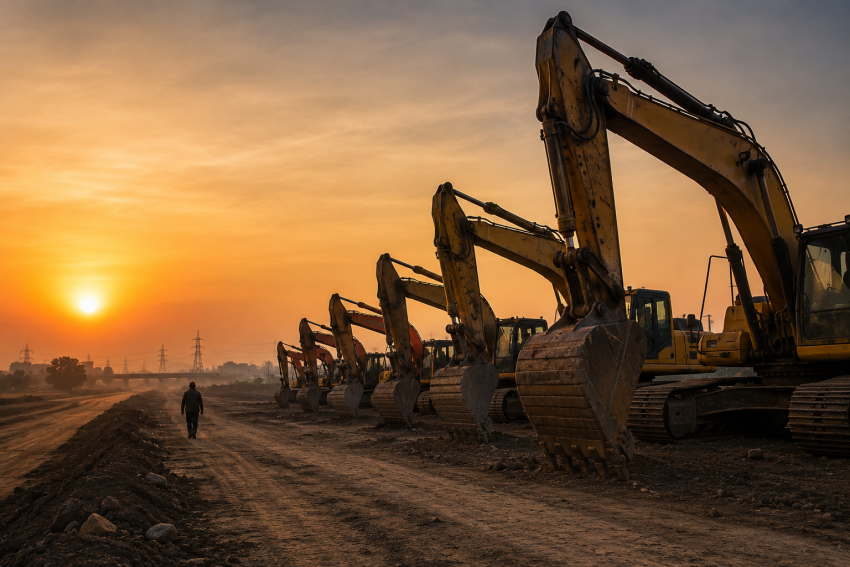
It may simply be how many machines are actually working.
That is where the real story of India’s post-monsoon infrastructure cycle will be visible.