GST Reforms: What They Mean for India’s Infrastructure and Equipment Businesses
The Most Expensive Machine Is the One Standing Still
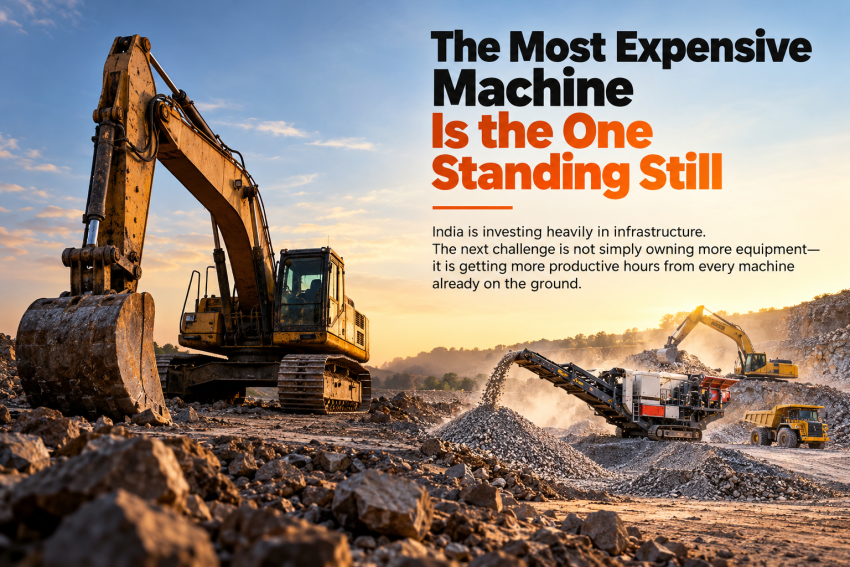
The Most Expensive Machine Is the One Standing Still
India is investing heavily in infrastructure. The next challenge is not simply owning more equipment—it is getting more productive hours from every machine already on the ground.
A ₹1 crore machine does not become productive merely because it has reached the project site.
If it is waiting for an operator, standing because a spare part has not arrived, stranded between two projects, working below the required capacity, or simply deployed on the wrong application, it is not really an asset for that period. It is capital waiting to be utilised.
That distinction is becoming increasingly important for India’s construction equipment industry.
The Union Budget for 2026–27 provides approximately ₹2.78 lakh crore of capital outlay for Indian Railways and ₹2.76 lakh crore for roads and bridges. Yet equipment demand has not moved in a straight line with infrastructure spending. ICRA noted that FY2026 remained subdued for construction equipment because of slower project execution, delayed awards, higher equipment costs and tighter financing, while projecting only a measured recovery in FY2027. (India Budget)
That apparent contradiction tells us something important.
India may not simply need more machines. India needs to use machines better.
From machine ownership to machine productivity
For decades, owning equipment was itself considered a sign of strength for contractors.
A large fleet meant capability. Machines on the balance sheet demonstrated scale. Owning rather than renting often felt safer.
But construction businesses are becoming increasingly capital-conscious.
Consider a contractor who needs an excavator for a 15-month project. Purchasing may make complete sense if there is visibility of continuous deployment thereafter.
Now consider another contractor who needs the same excavator for six months, followed by an uncertain gap before the next project.
Technically, both need exactly the same machine.
Financially, they have completely different requirements.
And that is why the industry's conversation is gradually moving away from the simple question:
“Which machine should I buy?”
towards a more sophisticated one:
“What is the most efficient way to obtain the equipment capacity I need?”
Sometimes the answer will still be ownership.
Sometimes it will be rental.
Sometimes leasing.
Sometimes a used machine.
And increasingly, sophisticated companies will probably use a combination of all four.
The real cost of an idle machine is rarely visible
Purchase price and monthly rental are easy to compare because both appear clearly on a spreadsheet.
Idle time does not.
Neither do many of the costs surrounding it.
An equipment owner carries depreciation, interest or financing cost, insurance, manpower, preventive maintenance, storage and administrative overhead even when the machine is not earning.
But there is another side to utilisation that is even more important.
A machine working at a project but suffering repeated breakdowns may technically be “deployed” while still destroying project economics.
A crusher running far below required throughput can delay an entire downstream operation.
A crane awaiting mobilisation can hold up erection activity.
An excavator without the right attachment can be busy without being productive.
Utilisation and productivity are not the same thing.
The industry will increasingly have to measure not merely where the machine is, but what the machine is producing while it is there.
The ₹100 machine can be more expensive than the ₹120 machine
Equipment procurement often becomes overly focused on the lowest visible rate.
Suppose one machine costs ₹100 to operate and another costs ₹120.
The ₹100 option appears cheaper.
But if the cheaper machine suffers higher downtime, consumes more fuel, produces less output per hour or takes longer to repair, the ₹120 machine may ultimately produce each tonne, cubic metre or kilometre at a lower cost.
This becomes particularly important in mining, crushing, excavation, road construction and large earthmoving jobs, where productivity differences multiply over millions of tonnes or thousands of operating hours.
The meaningful comparison therefore isn't always:
Rental per month.
It may be:
Cost per productive hour.
Or cost per tonne.
Or cost per cubic metre.
Or cost per kilometre completed.
That is a far more powerful way of evaluating equipment.
New equipment will remain important—but so will the second life of machines
India will undoubtedly continue buying new construction equipment.
Emission standards, technology, telematics, fuel efficiency, safety features and productivity improvements will continue pushing fleet replacement. The move to CEV-V emission norms has already increased equipment costs and affected purchasing behaviour. (ICRA)
But there is another opportunity sitting inside the existing equipment population.
Professionally refurbished equipment.
A properly inspected, rebuilt and maintained machine can serve projects that may not economically justify buying a brand-new asset.
This does not mean every old machine deserves another life.
There is a huge difference between an ageing machine sold cheaply and a machine whose structural condition, powertrain, hydraulics, service history and remaining economic life have been professionally assessed.
India's used-equipment market will mature when buyers and renters stop asking only:
“What year is the machine?”
and start asking:
“What productive life remains in the machine?”
That is a much more meaningful question.
Availability may become as important as ownership
Construction schedules are becoming tighter.
A project requiring an excavator next week may gain little from knowing that the company owns one 1,500 kilometres away.
The machine theoretically exists.
Operationally, it is unavailable.
This is where the equipment industry can learn something from several other sectors.
People increasingly buy access to capacity, rather than capacity itself.
Cloud computing transformed servers into computing capacity on demand.
Logistics platforms turned individual trucks into transport capacity.
Hotels transformed rooms into searchable inventory.
Construction equipment is obviously far more complex—machines require operators, transport, maintenance, application matching and field support—but the underlying economic idea is similar.
A contractor ultimately requires productive equipment at a particular location, for a particular period, at an acceptable cost.
Who owns the serial number may become less important than whether the machine can reliably perform the work.
And this changes the role of technology
The first generation of construction-equipment digitalisation concentrated heavily on listings and leads.
The next generation will have to solve harder problems.
Where is the machine?
Is it actually available?
How many hours has it worked?
What attachment does it carry?
When was it last serviced?
What is its breakdown history?
Can it be transported economically?
Does its configuration match the application?
Can financing, insurance, operators, spares and maintenance travel with the machine?
Once these questions can be answered reliably, equipment stops behaving like an isolated physical asset and starts becoming part of a connected industrial network.
That could dramatically improve utilisation across the industry.
The industry may eventually stop celebrating fleet size
For many years companies proudly said:
“We own 500 machines.”
Perhaps the more meaningful statement in future will be:
“Our fleet achieves 85% productive utilisation.”
That is a different mindset.
And potentially a much more profitable one.
India's infrastructure ambitions remain enormous. The construction sector itself is expected to regain momentum in FY2027 after two relatively subdued years, supported by improving project execution and government spending. (ICRA)
Meeting those ambitions will unquestionably require more construction equipment.
But it will also require something less visible:
better deployment of the machines India already has.
Because ultimately, the most valuable construction machine is not necessarily the newest machine, the biggest machine or even the cheapest machine.
It is the machine that is working—at the right site, on the right application, for the maximum number of productive hours.
And the most expensive machine?
Very often, it is the one standing still.